How to Get Your Beauty Business Named When Clients Ask ChatGPT
 Grant Kantsios
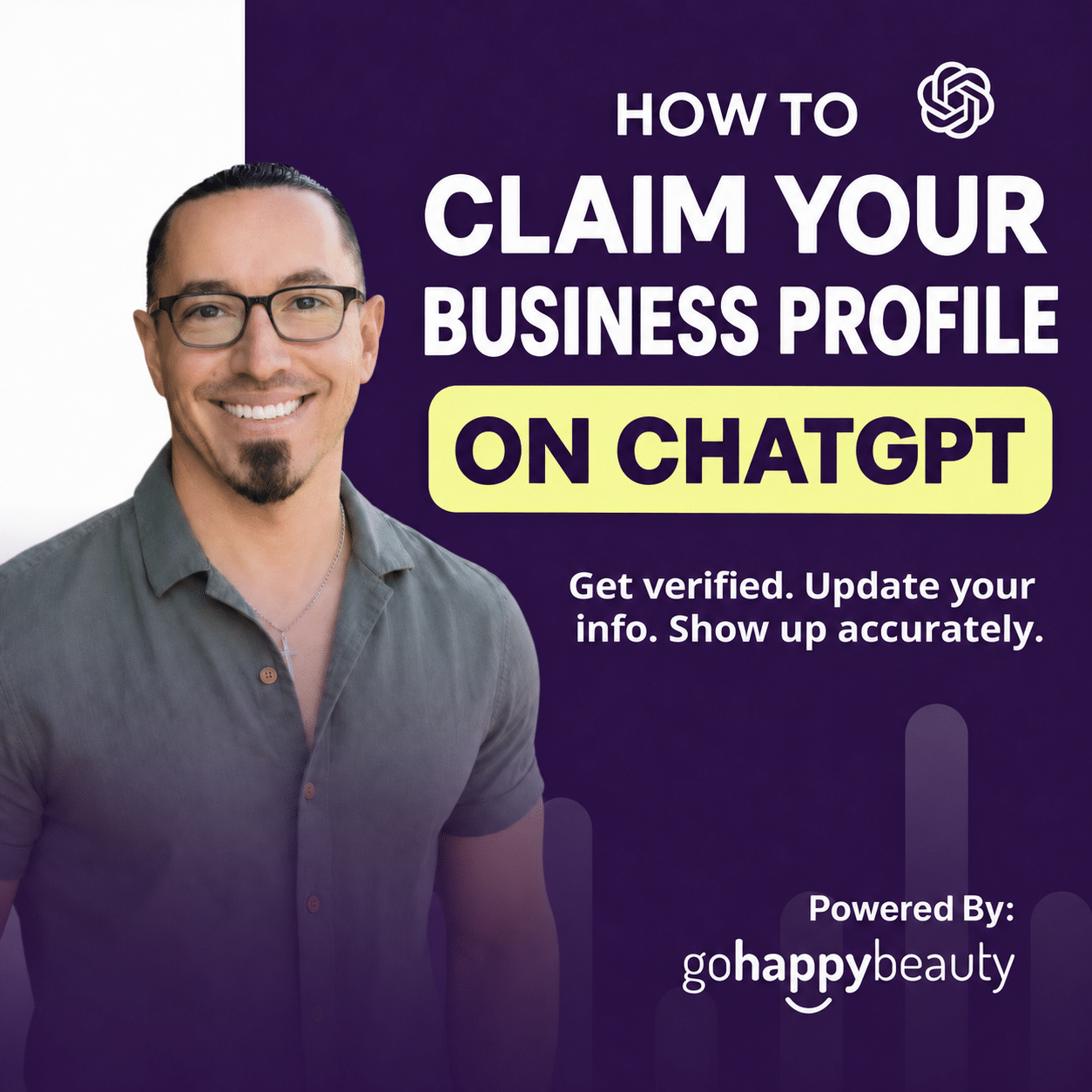
A client in your town opens ChatGPT and types “best spray tan near me,” “lash lift in [your city],” or “esthetician nearby.” ChatGPT looks at the web, then names a few businesses. The question is whether yours is one of them.
There is no ChatGPT ranking you can claim or buy. On November 10, 2026, OpenAI launched Businesses in ChatGPT in beta, and it is blunt about what that does not do: claiming your business “does not guarantee higher placement or sales.” What you can do is make your website easy for ChatGPT to find, say in plain words what you do and where you are, and show up on the pages it cites.
This guide is for spray tan, lash, esthetician, nail, and salon owners. The steps come from OpenAI’s own documentation, research we cite along the way, and a 20-prompt check we ran on November 10, 2026.
Prefer to watch? I walk through claiming a ChatGPT business profile in the video below. Use this guide as your checklist.
Why does ChatGPT name some studios and not others?
When a question needs current information, ChatGPT can search the web. OpenAI says that when it uses a search partner, it “typically rewrites your query into one or more targeted queries” and sends those along. A client might type “spray tan near me.” ChatGPT might search “best spray tan [your city].” It can also use a rough location, and on phones it may show a map.
To see what those searches look like for a different kind of business, the research firm FirstIndex logged 102 ChatGPT answers on November 10, 2026. Their questions were about SEO and AI-visibility agencies for software companies, not beauty studios, on a single day. They call it a pattern, not a law. ChatGPT searched the web in every one of the 102 answers, about twice per answer. 110 of its 203 searches (54%) added the year “2026,” and 63 (31%) used words like best, top, vs., or alternatives. In only 16 of the 102 answers did it search a brand’s name before mentioning it. Of the 1,059 links it cited, nearly half went to companies’ own homepages and about a quarter to lists and comparison pages. 79 of the 102 answers (77%) cited at least one list or comparison.
If ChatGPT does not already know your name, your way in is the pages those searches find. For a local studio, that includes a clear homepage, honest service-comparison pages, local “best of” lists, and the directory profiles you already have.
A pretty headline that never names your service or your town gives ChatGPT very little to quote. Say what you do, where you are, and who it’s for.
What happened when we asked ChatGPT for a studio nearby?
On the evening of November 10, 2026, around 11 p.m. Eastern, we asked ChatGPT 20 local beauty questions, logged out on chatgpt.com. Each prompt was a fresh chat, and web search ran on its own every time. This is a one-time snapshot, not a ranking study. A logged-out session does not always show a full source list, so we only counted sources we could actually read.
In 7 of the 20 answers we could not see any readable sources. In the answers we could read, some prompts had more than one source type:
- Directory pages were among the visible sources on 8 of the 20 prompts, including Booksy, Fresha, GlossGenius, Birdeye, BestProsInTown, WeddingWire, and Revelle. We are naming them only as sources ChatGPT cited in this run, not as a product comparison.
- A business’s own website was among the visible sources on 8 of the 20 prompts.
- A local “best of” list or local press appeared on 3 prompts.
- Google appeared once, and only as a Directions link on a place card. We did not see Yelp, Apple Maps, or Reddit as sources. Map cards were credited to Mapbox and OpenStreetMap.
Be listed on the directory and marketplace profiles you already use, have your own website, and get onto local lists. One prompt had a typo and was not re-run.
Can ChatGPT even find my website?
Before you rewrite a page, make sure ChatGPT is allowed to read your site. This is part of ordinary search engine optimization: if the crawler can’t see the page, you can’t show up.
Allow OAI-SearchBot in robots.txt. OpenAI’s crawler documentation says sites that opt out “will not be shown in ChatGPT search answers,” though they can still appear as ordinary navigational links. A change can take about 24 hours to count.
User-agent: OAI-SearchBot
Allow: /
Don’t let your host or CDN block the crawler. A robots.txt rule is not enough if bot protection turns the crawler away. OpenAI’s search help says to allow OAI-SearchBot and allow traffic from its published SearchBot IP addresses, listed at openai.com/searchbot.json. Allowlist those ranges, and check that the crawler is not hitting a CAPTCHA, a challenge page, or a 403 error. If you use Cloudflare, this is no longer one “block AI bots” switch. In 2026 Cloudflare split that control into Search, Agent, and Training. Only a Search block targets OAI-SearchBot. A Training block is a separate setting for GPTBot, which does not control search. An Agent block is for ChatGPT-User, which OpenAI says is not used to decide what appears in search. Confirm that Search is allowed, allowlist the SearchBot IP ranges, and plan on about 24 hours for a change to count.
Get the site into Bing, and use IndexNow when a page changes. ChatGPT sometimes sends rewritten queries to search partners, and OpenAI’s search help points to the Microsoft privacy statement for how those partners may handle the queries. Add and verify your site in Bing Webmaster Tools (manually, or by importing a verified Google Search Console property). Then use IndexNow. The official registry currently includes Bing, Yandex, Seznam, Naver, Yep, the Internet Archive, and Amazonbot. Google is not a participant, and there is no ChatGPT or OpenAI entry. IndexNow does not guarantee a page will be crawled or indexed, and it is not a confirmed switch for ChatGPT.
On WordPress, automate those pings with the IndexNow plugin, Yoast SEO Premium, or Rank Math. On Cloudflare, Crawler Hints can send the same signals when content changes.
What should my homepage actually say?
In FirstIndex’s study, when ChatGPT named a company, the homepage was the link it used most. Make the first screen of your site do real work.
Write it the way you would tell a new neighbor. Say what you do, the city or neighborhood you serve, and who it is for.
A weak opening sounds like: “Welcome to our oasis. Glow starts here.”
A stronger one sounds like: “Sunlit Glow is a spray tan studio in Midtown Atlanta for clients who want a natural-looking tan without a tanning bed.”
Do the same on your main service pages: “Lash lift and tint in [city],” or “Mobile spray tan serving [city and nearby towns].” Put your business name, address or service area, and phone number on the site in ordinary text, not only in an image or a buried footer. That holds whether you run a spray tan studio, a lash business, an esthetician practice, or a nail salon.
Should I add pages that compare my services?
Often, yes. FirstIndex found that more than three in four of the answers it logged cited at least one list or comparison page, and about a third of ChatGPT’s searches used words like best, vs., or alternatives.
For a beauty business, that usually means honest pages that answer the questions clients already ask: spray tan vs. tanning bed, lash lift vs. extensions, classic lashes vs. volume, a hydrating facial vs. a deeper treatment, or gel manicure vs. dip powder.
Write these in your own words. Explain who each option is for, how long it lasts, and when you would recommend one over the other. If you offer both, say so. If you only offer one, say why, fairly.
Keep the dates current. In the FirstIndex sample, more than half of ChatGPT’s searches added the year. When you change a service or an aftercare note, update the page and show a visible “last updated” date.
How do I get onto “best spray tan in [city]” lists?
Most of the editorial lists ChatGPT reads will not be yours. They belong to local magazines, neighborhood blogs, and “best of” roundups. In our snapshot, a local list or local press was a visible source on 3 of the 20 prompts.
Ask ChatGPT the questions your clients ask, then open its sources. Where you are a genuine fit, reach out and send what the writer needs: what you offer, where you are, who you serve, and a link to your site. Do not pay for a spot on a list, and do not buy reviews. OpenAI’s Businesses in ChatGPT policy also bars fabricated reviews and endorsements on a claimed profile.
You can publish a helpful guide of your own, such as “how to choose a spray tan in [city],” that teaches first and mentions your studio in context. That is not a substitute for other people’s lists. In FirstIndex’s software-agency sample, directories barely showed up (3 of 1,059 links). In our local beauty snapshot, they were among the visible sources on 8 of the 20 prompts. Keep the directory profiles you already have complete and consistent with your website.
What about Google, Apple Maps, and Yelp?
In that same snapshot, Google, Apple Maps, and Yelp were not visible sources in the ChatGPT answers we could read. Google appeared once, and only as a Directions link on a place card. We did not see Yelp or Apple Maps cited at all.
That does not make those listings optional. Clients still look you up there, and a consistent name, address or service area, phone number, and website still matter for local search.
- Google Business Profile. Claim and verify it, then keep your name, address or service area, hours, phone, website, and categories current. Respond to reviews there too.
- Apple Business Connect. Apple’s free tool for claiming and updating your place card in Apple Maps and other Apple apps.
- Yelp. Claim your page, fix outdated details, and respond to reviews.
Use the same details on all three, and on your own site.
Should I claim my studio in ChatGPT?
Yes, if you can. It will not buy you a higher spot in the answers, but it lets you correct your information and, once verified, see how often you are mentioned.
Businesses in ChatGPT opened in beta on November 10, 2026. In Business Hub, eligible businesses can claim a profile, update key details, and view mentions, website clicks, and “discovery topics.” Insights cover about the past 28 days, appear only when activity crosses a privacy threshold, and do not include people’s chats.
Sign in to ChatGPT and open Business Hub from the sidebar. Search for your business, then verify with a business phone, business email, website domain, or Shopify. Eligibility depends on industry, location, and OpenAI’s checks, and you need a website to claim. After the claim is approved, Persona identity verification is required before you can publish changes or view insights. The blue check appears after that step is approved, not merely after you start a claim.
OpenAI’s policy allows a profile to include an address or a service area, along with hours, contact details, and services. Whether a mobile studio with no storefront can claim a profile today is not something we have confirmed in the live claim flow. If you have a website, look for an existing U.S. listing first. OpenAI’s help says local stores and restaurants can currently claim only an existing U.S. listing. If nothing comes up, you may have to wait.
For a local business, a mention counts when ChatGPT shows a result for that location, even if the person does not open the listing or visit your website. Business Agents are limited to eligible ecommerce and online service businesses in the United States. A typical local studio may claim a profile without being eligible for an agent. Claim it for accurate facts, not for an agent you may not get yet.
OpenAI again: ChatGPT “continues to make independent recommendations and comparisons. Claiming does not guarantee higher placement or sales.”
What can I skip?
An llms.txt file. In October 2026, SE Ranking analyzed 300,000 domains and found no link between having an llms.txt file and how often a site was cited by AI. Only 10.13% of those domains had the file. In April 2025, Google’s John Mueller said that, as far as he knew, none of the AI services had said they use llms.txt, and compared it to the old keywords meta tag. It is not the work that gets a studio named.
Schema “tricks” sold as a shortcut into ChatGPT. LocalBusiness schema that repeats your name, address or service area, and phone is basic hygiene for search engines. It should match the text already on the page. It is not a magic ticket into ChatGPT answers. Plain words that answer the client’s question do that job.
How will I know if this is working?
Count, don’t spot-check. The same question can name you today and skip you tomorrow. Our 20-prompt evening is why one pass is not enough.
Pick the questions a real client would ask in your city. Ask each one several times, on different days. Track the share of answers that name your studio, and note which pages were cited when you appeared or a competitor did. That share, over many runs, is the number that matters.
After you claim and verify your business, add Business Hub mentions and website clicks. FirstIndex published its own early numbers as an example, not a beauty-industry benchmark: from October 14 to November 10, 2026, Business Hub counted 282 ChatGPT answers that referenced firstindex.com, and 6 clicks. If you only watch traffic from ChatGPT, you can miss most of the times you were named.
We can do this with you
This is the work we already care about at gohappybeauty: a done-for-you website for beauty businesses, set up to be found online, with SEO included from the start.
If your homepage buries what you do, or if you want help writing and updating the pages clients, Google, and ChatGPT can actually use, we can do that with you. See website plans and pricing, or our month-to-month Booked-Out SEO plan for audits, local pages, and new articles. Or contact us at 980-385-4200.
Got questions about showing up in ChatGPT? I’ve got answers
Can ChatGPT recommend my salon or studio?
Yes. When someone asks for a nearby spray tan, lash artist, or esthetician, ChatGPT can search the web and name businesses from the pages it finds. There is no ranking you can buy. OpenAI says claiming a business profile does not guarantee higher placement.
Do I need to allow OAI-SearchBot on my website?
Yes, if you want a chance to appear in ChatGPT search answers. OpenAI says sites that opt out of OAI-SearchBot will not be shown in those answers, and a robots.txt change can take about 24 hours to count. If you use Cloudflare, only a Search block affects OAI-SearchBot. A Training block is a separate setting for GPTBot. Also allow OpenAI’s published SearchBot IP addresses.
Does claiming my business in ChatGPT make me show up more often?
No. Claiming lets you manage your information and, once verified, see how often ChatGPT mentions you. OpenAI is clear that claiming does not guarantee higher placement or sales, and that ChatGPT keeps making its own recommendations. You need a website to claim. Whether a mobile business with no storefront can claim is not something we have confirmed.
Will an llms.txt file or special schema get me into ChatGPT?
There is no good evidence that it will. A 2026 SE Ranking study of 300,000 domains found no link between having an llms.txt file and being cited by AI. LocalBusiness schema that matches your name, address or service area, and phone is basic hygiene, not a shortcut. Write those details on the page in plain text.
How do I know if ChatGPT is naming my studio?
Don’t check once and call it done. The same question can name you today and skip you tomorrow. Pick the questions clients actually ask, run each one several times, and track the share of answers that name you. After you claim and verify your business, ChatGPT’s Business Hub also shows mentions and website clicks.
Grow your beauty business
Our focus is, and always will be, helping you improve your online presence and generate more business from your website. That is what we do, for you.