 Grant Kantsios
Running a successful spa requires more than just exceptional services and a serene atmosphere. It demands a strategic marketing plan that consistently attracts new clients and, more importantly, turns them into loyal advocates for your brand. In a competitive wellness market, relying solely on word-of-mouth recommendations is no longer a viable growth strategy. To truly thrive, you need a diverse toolkit of proven, actionable spa marketing ideas that you can implement right away to fill your appointment book and build a lasting community.
This guide is designed to cut through the noise and deliver precisely that. We've compiled nine powerful, easy-to-follow strategies tailored specifically for spas, salons, and beauty professionals. Forget vague theories and generic advice. Each item on this list is broken down into practical steps, complete with real-world examples and insider tips, ensuring you have everything needed to elevate your brand's visibility and drive tangible results.
From mastering local SEO with Google My Business to creating irresistible membership programs and leveraging strategic partnerships, you will find concrete instructions to enhance your marketing efforts immediately. Whether you're an esthetician, lash artist, or a multi-location spa owner, these insights are your blueprint for sustainable growth. Let’s explore the marketing strategies that will not only attract new faces but also foster the deep-seated loyalty that defines a successful wellness business.
1. Membership and Loyalty Programs
Transforming one-time visitors into dedicated regulars is the cornerstone of sustainable spa growth. Implementing a well-structured membership or loyalty program is one of the most effective spa marketing ideas for achieving this, as it creates predictable recurring revenue and fosters a strong sense of community. Instead of just hoping clients return, you provide a compelling, value-driven reason for them to commit to your brand for their ongoing wellness needs.
This strategy shifts the business model from transactional to relational. A membership typically involves a recurring monthly or annual fee in exchange for a set number of services at a discounted rate, priority booking, and exclusive perks. Loyalty programs, on the other hand, reward clients based on their spending or visit frequency, often using a points-based system. Both approaches incentivize repeat business and increase the lifetime value of each customer.
How to Implement a Spa Membership Program
To launch a successful program, focus on creating irresistible value and seamless execution.
- Step 1: Structure Your Tiers. Design two to three membership levels to appeal to different client needs and budgets. For instance, create a "Glow" tier with one 60-minute facial per month, and a "Radiance" tier offering two services, complimentary add-ons, and retail discounts.
- Step 2: Set Strategic Pricing. Calculate your baseline operational costs per service. Price your memberships so the monthly fee is 15-25% less than the standard price of the included services. This makes the value immediately obvious and encourages sign-ups.
- Step 3: Define Exclusive Perks. Offer members-only benefits that go beyond simple discounts. Ideas include priority booking slots, access to new treatments before the public, or invitations to exclusive quarterly wellness events.
- Step 4: Automate and Simplify. Use your spa management software to automate monthly billing, track service usage, and manage member profiles. Ensure the sign-up process is simple and can be completed online or at the front desk in under two minutes.
For an in-depth guide on designing a program that resonates with your clients, you can explore detailed strategies on how to create effective loyalty programs. This powerful spa marketing idea not only secures consistent income but builds a loyal clientele that becomes the foundation of your business.
2. Instagram and Social Media Visual Marketing
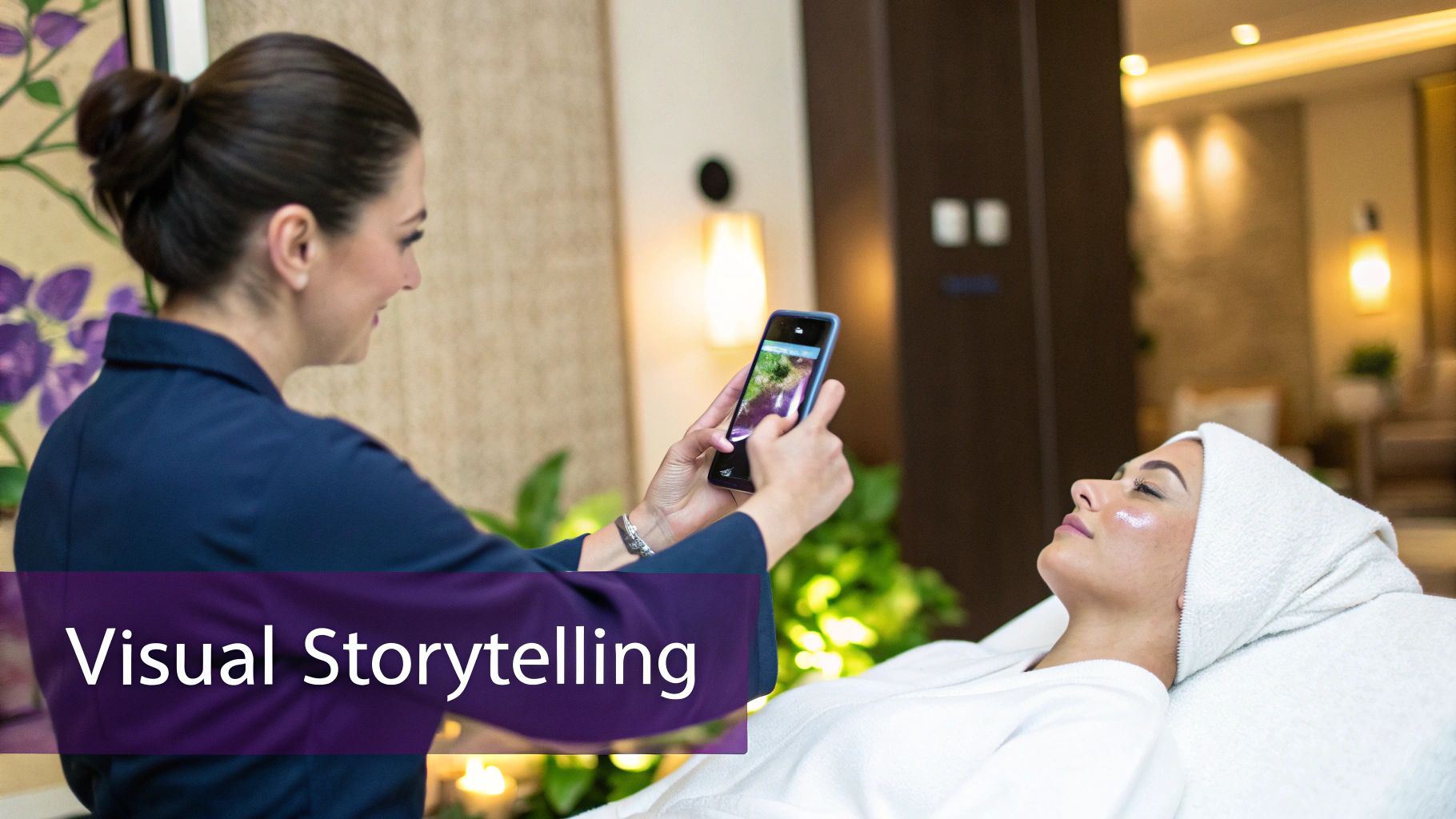
In an industry where atmosphere and results are paramount, visual storytelling is your most powerful asset. A strategic social media presence on platforms like Instagram, TikTok, and Pinterest is one of the most effective spa marketing ideas for translating your spa's serene ambiance and transformative services into tangible desire. Instead of just describing your offerings, you can visually immerse potential clients in the experience before they even book an appointment.
This approach moves beyond simple promotion to brand building and community engagement. By showcasing high-quality photos and videos of your tranquil spaces, treatment results, and expert staff, you build trust and aspiration. Platforms like Instagram and TikTok are perfect for demonstrating the value of your services through compelling before-and-afters, behind-the-scenes glimpses, and educational content that positions your spa as a leading wellness authority.
How to Implement a Visual Social Media Strategy
A successful visual marketing plan relies on consistency, quality, and a clear call-to-action.
- Step 1: Create a Content Bank. Schedule a quarterly photoshoot to capture your spa’s ambiance, treatment rooms, and staff. Supplement this with high-quality smartphone videos for authentic, "in-the-moment" content like Reels and Stories.
- Step 2: Showcase Transformations and Ambiance. Your feed's focus should be on results and experience. Post compelling before-and-after photos (always with client permission) and use atmospheric video clips, like a steaming hot towel or a serene treatment room, to sell the feeling of your spa.
- Step 3: Leverage Video for Education. Create short-form videos (Reels or TikToks) explaining the benefits of different treatments, sharing at-home skincare tips, or introducing your therapists. This builds authority and a personal connection with your audience.
- Step 4: Use a Clear Call-to-Action (CTA). Every post must tell followers what to do next. End your captions with a direct instruction like, "Tap the link in our bio to book your facial," or "Comment below with your biggest skincare question!" This simple step turns passive viewers into engaged potential clients.
- Step 5: Engage Actively and Consistently. Post 3-5 times per week during peak engagement hours. Use your city's location tag to attract local clients. Respond to all comments within a few hours to boost your visibility and show excellent customer service.
3. Partnership Marketing with Local Businesses
Tapping into an existing, trusted customer base is one of the most efficient spa marketing ideas available. By forming strategic alliances with complementary, non-competing local businesses, you can access a new audience that is already primed to appreciate your services. This grassroots approach builds valuable community ties and creates a powerful referral network that drives qualified leads directly to your door.
This strategy is built on mutual benefit. You partner with businesses that share your target demographic, such as upscale hotels, fitness studios, or bridal boutiques, to cross-promote each other. The endorsement from a trusted local brand provides a level of credibility that traditional advertising often lacks. A recommendation from a favorite yoga studio or a luxury hotel concierge carries significant weight, making potential clients more likely to book an appointment.
How to Implement a Local Partnership Strategy
To launch a successful collaboration, focus on finding the right partners and creating offers that benefit everyone involved.
- Step 1: Identify Aligned Partners. Make a list of local businesses whose clientele matches yours. Think beyond the obvious: consider bridal shops, high-end fitness studios, corporate wellness programs, and luxury apartment concierges.
- Step 2: Create a Co-Branded Package. Develop an exclusive, bundled offer that provides clear value. For example, partner with a yoga studio to offer a "Mind & Body Reset" package that includes a yoga class and a massage at a special combined price.
- Step 3: Establish Clear Terms. Draft a simple one-page agreement. Outline what each partner will do (e.g., one email blast, three social media posts), the duration of the partnership (start with a 90-day trial), and how you'll track success (e.g., a unique discount code like "YOGASPA25").
- Step 4: Leverage Their Network. Prioritize partners with strong marketing channels, like an engaged email list. For an extra layer of endorsement, learn how to find local influencers who can authentically promote your collaboration.
This powerful spa marketing idea transforms neighboring businesses from competitors into collaborators, creating a community-focused ecosystem that drives sustainable growth for everyone.
4. Google My Business Optimization and Local SEO
For spas, which rely heavily on foot traffic, dominating local search results is non-negotiable. Optimizing your Google My Business (GMB) profile and leveraging local SEO is a powerful spa marketing idea that ensures you appear when potential clients search "spa near me" or "facials in [your city]." Since nearly half of all Google searches have local intent, a strong local presence puts your spa directly in front of an audience actively looking to book a service.
This strategy transforms your online listing from a simple digital business card into a dynamic client acquisition tool. It involves enriching your GMB profile with up-to-date information, high-quality photos, and consistent client reviews, while also optimizing your website for location-specific keywords. This ensures that when a local customer seeks relaxation or a specific treatment, your spa is the first and most credible option they see.
How to Implement Local SEO and GMB Optimization
To capture local search traffic, focus on making your spa the most relevant and authoritative answer for Google in your service area.
- Step 1: Claim and Complete Your Profile. Go to google.com/business, claim your listing, and fill out every single section. Pay close attention to selecting the right primary and secondary business categories (e.g., "Day Spa," "Massage Therapist," "Skincare Clinic").
- Step 2: Build a Visual Showcase. Upload at least 30 high-quality photos of your spa's exterior, interior, treatment rooms, and team. Add a few new photos every month to signal to Google that your business is active.
- Step 3: Actively Manage Reviews. Make it a goal to respond to all reviews—positive and negative—within 24 hours. This shows potential clients you value feedback. After a great service, ask your happy clients directly, "Would you mind leaving us a quick review on Google? It helps our small business a lot."
- Step 4: Use GMB Posts Weekly. Use the "Posts" feature 1-2 times per week to highlight special offers, new services, or last-minute appointment availability. Think of it as a free mini-ad on your Google profile.
To ensure your spa ranks high in local searches and attracts nearby clients, refer to this ultimate local SEO checklist for 2025. For a deeper dive into the fundamentals, you can also explore this guide on what local SEO marketing entails. This essential spa marketing idea is a low-cost, high-impact way to drive qualified leads directly to your door.
5. Email Marketing with Segmentation and Automation
Moving beyond generic monthly newsletters is crucial for connecting with clients in a crowded inbox. A sophisticated email strategy, centered on segmentation and automation, is one of the most powerful spa marketing ideas because it delivers highly personalized, timely messages. Instead of sending the same promotion to everyone, you can tailor communications based on a client's behavior, preferences, and history with your spa.
This approach transforms your email list from a simple broadcast tool into a dynamic relationship-building engine. Segmentation involves grouping your audience by specific criteria like service preferences (massage vs. facial clients), spending habits, or visit frequency. Automation then uses these segments to send triggered emails, such as a special offer for a client's birthday or a gentle reminder to someone who hasn't visited in a few months. This targeted approach ensures your messages are relevant, welcome, and effective.
How to Implement a Segmented Email Strategy
To launch a successful email program, focus on personalization at scale and providing genuine value in every send.
- Step 1: Segment Your Audience. Start with four simple groups: new clients (first visit in 30 days), regulars (visited 3+ times), VIPs (top 10% spenders), and lapsed clients (no visit in 90+ days).
- Step 2: Automate Key Touchpoints. Set up automated emails for critical moments. Create a "welcome series" for new subscribers, appointment reminders, a birthday greeting with an exclusive offer, and a "we miss you" campaign with a special discount for lapsed clients.
- Step 3: Personalize Your Content. Go beyond using just the client's first name. Reference their last service ("We hope you enjoyed your deep tissue massage!") or suggest a complementary treatment based on their history. This detail shows you are paying attention.
- Step 4: Test and Optimize. Send your emails on Tuesdays or Thursdays between 10-11 am, as this is a common peak time. A/B test your subject lines to see what gets more opens. For example, try "A Special Offer Just For You" vs. "Relaxation Awaits, [Client Name]!"
To get started, focus on growing your database by collecting emails at every touchpoint. For a comprehensive overview of effective list-building techniques, you can explore detailed strategies on how to build a powerful email list. This targeted spa marketing idea will help you build stronger client relationships and generate a significant return on your marketing investment.
6. Seasonal Packages and Limited-Time Offers
Creating a sense of urgency and catering to timely needs is a powerful spa marketing idea that can significantly boost revenue and attract new clients. Developing seasonal packages and limited-time offers (LTOs) leverages holidays, changing seasons, and cultural events to create compelling, time-sensitive reasons for customers to book an appointment now. This strategy addresses specific seasonal desires, like summer-readiness treatments or holiday stress relief, turning a "maybe later" thought into an immediate sale.
This approach capitalizes on the psychological principle of scarcity, making an offer feel more valuable because it won't be available forever. By bundling services into themed packages, you can increase the average transaction value while delivering exceptional value to your clients. Successful implementation can smooth out revenue fluctuations throughout the year, creating predictable sales spikes during key periods like Mother's Day, Valentine's Day, and the winter holidays.
How to Implement Seasonal Spa Packages
To launch a successful seasonal campaign, you need to combine strategic planning with creative, value-driven offers.
- Step 1: Plan Your Promotional Calendar. At the start of each year, map out your key promotions. Focus on major holidays (Valentine's Day, Mother's Day, Christmas) and seasonal shifts (Spring Renewal, Summer Glow, Fall Harvest).
- Step 2: Create Irresistible Bundles. Combine a popular service with a less-booked one to introduce clients to your full menu. Price the package 15-20% less than the total cost of the individual services to clearly show the value. For example, a "Winter Warm-Up" package could bundle a hot stone massage with a hydrating facial.
- Step 3: Build Urgency and Scarcity. Clearly state the offer's time limit. Use phrases like "Available only in February" or "Book by Friday to receive a complimentary gift." Adding a countdown timer to your website booking page can dramatically increase conversions.
- Step 4: Optimize for Gifting. For holidays like Mother's Day, design specific gift certificate templates and offer elegant gift-wrapping. Promote these heavily as the perfect, easy gift, turning your services into a tangible present.
The timeline below illustrates how to structure a promotional calendar around key annual events to maximize bookings.
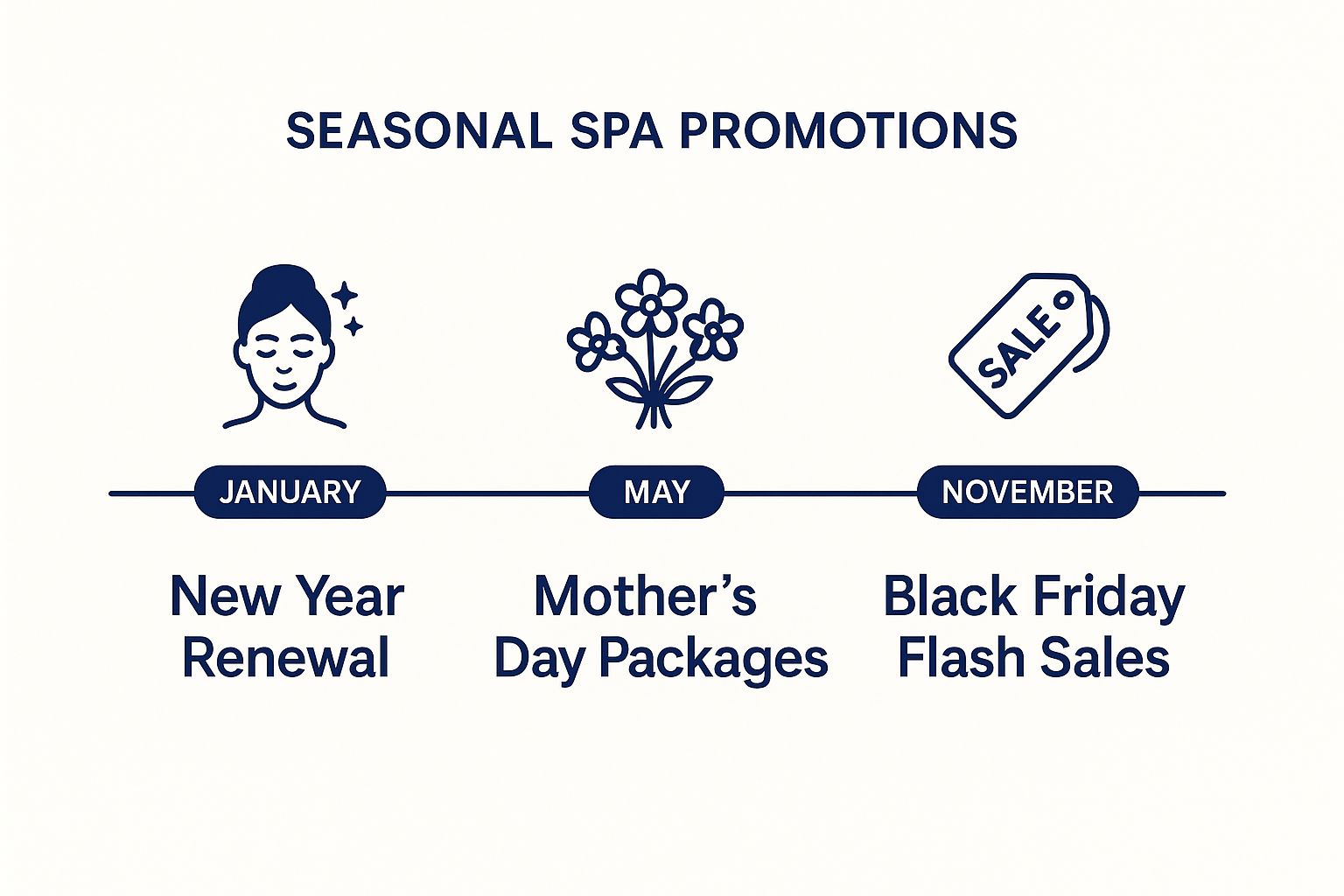
This visual shows how planning promotions around key milestones like New Year's resolutions, Mother's Day, and Black Friday creates a consistent rhythm of high-value offers that drive sales throughout the year.
7. Referral Programs and Client Advocacy Incentives
Leveraging your existing happy clients to attract new ones is one of the most cost-effective and powerful spa marketing ideas available. A structured referral program transforms satisfied customers into active brand advocates, tapping into the immense power of word-of-mouth recommendations. Since consumers overwhelmingly trust suggestions from friends and family over traditional advertising, this strategy builds a pipeline of high-quality, pre-qualified leads with a higher retention rate.
This approach systemizes the referral process, moving it from a passive hope to an active, incentive-driven engine for growth. Instead of just delivering an excellent service and wishing clients will tell their friends, you provide a clear, compelling reason for them to do so. A successful program rewards both the referrer for their loyalty and the new client for trying your spa, creating a win-win scenario that fosters community and drives new bookings.
How to Implement a Spa Referral Program
To build a referral program that generates consistent results, focus on making it valuable, simple, and easy to track.
- Step 1: Offer a Compelling Dual-Sided Incentive. The best programs reward both people. A simple and effective offer is "$20 for you, $20 for your friend." This motivates the existing client to share and makes it an easy decision for the new client.
- Step 2: Make Sharing Effortless. The process must be simple. Provide clients with small, beautifully designed referral cards at checkout that they can hand to friends. Also, use your booking software to generate a unique referral link they can share via text or email.
- Step 3: Systematize the "Ask." Train your front desk staff to mention the program at checkout after a client expresses satisfaction. A simple script works best: "We're so glad you enjoyed your facial! If you know anyone else who would love our services, we have a great referral program where you both get $20 off."
- Step 4: Track and Acknowledge Advocates. Use your CRM or booking software to track who is sending you the most referrals. Acknowledge your top advocates with a personal thank you note or a small, unexpected gift to show your appreciation and encourage more sharing.
For a deeper dive into the mechanics of building a program that scales, you can learn more from referral marketing experts like John Jantsch. This strategy is an essential spa marketing idea because it leverages your most authentic asset: the trust your clients have in your services.
8. Content Marketing and Educational Blogging
Positioning your spa as a trusted wellness authority is a powerful long-term marketing strategy. Creating valuable, educational content establishes your expertise, builds trust with potential clients, and drives organic search traffic. Instead of simply promoting your services, you answer the questions your target audience is actively searching for online, such as “benefits of deep tissue massage” or “how to prepare for your first facial.”
This approach shifts your marketing from interruptive to attractive. By consistently publishing high-quality blog posts, guides, and videos, you capture clients early in their decision-making process. This spa marketing idea builds significant SEO authority over time, making it easier for new customers to discover you on Google. It also serves as a powerful engine for growing your email list and differentiating your brand from competitors who rely solely on discounts.
How to Implement a Spa Content Marketing Strategy
To launch a successful content strategy, focus on providing genuine value and addressing specific client pain points.
- Step 1: Research Key Topics. Use free tools like Google Trends or AnswerThePublic to find questions your audience is asking. Focus on topics directly related to your services, such as "How often should I get a facial?" or "Benefits of lymphatic drainage massage."
- Step 2: Create "Pillar" Content. Develop one comprehensive, in-depth article (1,500+ words) per month on a core service. For example, create an "Ultimate Guide to Facials" that covers different types, benefits, and aftercare. This builds authority with search engines.
- Step 3: Maintain a Consistent Schedule. Quality is more important than quantity. Aim to publish two well-researched blog posts per month. Consistency signals reliability to both readers and Google.
- Step 4: Include a Clear Call-to-Action. Every blog post should guide the reader on what to do next. End each article with a clear instruction, such as, "Ready to experience the benefits for yourself? Book your complimentary consultation here," with a direct link to your booking page.
By consistently creating educational content, you build a durable marketing asset that attracts, engages, and converts clients for years to come.
9. Influencer Partnerships and User-Generated Content Campaigns
Harnessing the power of social proof is one of the most potent modern spa marketing ideas. By collaborating with influencers and encouraging clients to share their own experiences, you can build authentic trust and expand your reach far beyond traditional advertising. This dual approach leverages both curated endorsements from trusted personalities and genuine content from your actual clientele, creating a powerful, multi-layered marketing engine.
This strategy capitalizes on the fact that consumers trust recommendations from peers and influencers more than direct brand messaging. Influencer partnerships involve paying or gifting services to social media creators in exchange for exposure to their engaged followers. User-Generated Content (UGC) campaigns, conversely, motivate your existing clients to create and share content featuring your spa, turning happy customers into active brand advocates. Both tactics build credibility and generate a library of authentic marketing assets.
How to Implement Influencer and UGC Campaigns
To launch a successful program, focus on authenticity, clear communication, and providing share-worthy experiences.
- Step 1: Target Local Micro-Influencers. Search on Instagram for hashtags like #[YourCity]Blogger or #[YourCity]Wellness. Look for influencers with 5,000-50,000 followers who live in your area and have high engagement (lots of comments from real people). Their audience is more likely to be local and convertible.
- Step 2: Formalize Your Agreements. Create a simple one-page agreement. Clearly state what you are providing (e.g., a complimentary 90-minute signature facial) and what you expect in return (e.g., one Instagram Reel and three Stories, with a link to book). Always require them to use #ad or #sponsored.
- Step 3: Launch a UGC Campaign. Create a simple, branded hashtag (e.g., #[YourSpaName]Glow) and display it prominently in your spa. Offer a monthly prize, like a free service, for the best client post using the hashtag. This encourages a steady stream of authentic content you can reshare.
- Step 4: Create "Instagrammable" Moments. Designate a specific spot in your spa that is perfect for photos. This could be a beautiful floral wall, a well-lit vanity station for post-treatment selfies, or a cozy relaxation lounge. This organically encourages clients to snap and share their experience.
By combining influencer reach with the genuine enthusiasm of your clients, this spa marketing idea creates a flywheel of social proof that attracts new clients and fosters a vibrant community around your brand.
Spa Marketing Strategies Comparison Matrix
| Marketing Strategy | Implementation Complexity 🔄 | Resource Requirements ⚡ | Expected Outcomes 📊 | Ideal Use Cases 💡 | Key Advantages ⭐ |
|---|---|---|---|---|---|
| Membership and Loyalty Programs | Medium – requires financial modeling and admin overhead | Moderate – CRM system and staff time needed | 20-40% ↑ in customer lifetime value; 60-70% retention | Established spas with steady client flow aiming for revenue stability and retention | Predictable recurring revenue; strong customer loyalty |
| Instagram and Social Media Visual Marketing | High – daily content creation, multi-platform management | Moderate – content creators, photographers, editing | 3:1 ROI on paid ads; organic drives 15-25% new inquiries | Spas wanting brand awareness and engagement via visual storytelling | Cost-effective; authentic audience connection; direct booking thru profiles |
| Partnership Marketing with Local Businesses | Medium-High – establishing and managing local relationships | Low to Moderate – coordination and co-marketing efforts | 10-20% new client acquisitions with low investment | Spas targeting complementary markets via collaborations | Cost-effective lead generation; builds community ties |
| Google My Business Optimization and Local SEO | Medium – ongoing maintenance and optimization | Low – setup & frequent updates required | 5:1 ROI; 30-50% website traffic from local search within 6 months | Spas targeting local clients seeking immediate services | High visibility in local search; free setup; trust via reviews |
| Email Marketing with Segmentation and Automation | Medium – setup of automation and segmentation | Low to Moderate – email platform and content creation | $38-42 ROI per $1 spent; segmented campaigns boost by 50% | All spa sizes aiming to maximize client retention & upsell | Highest digital ROI; personalized communication; automation reduces manual tasks |
| Seasonal Packages and Limited-Time Offers | Medium – planning, staff training, and tracking | Low to Moderate – marketing and staff coordination | 25-60% revenue increase in peak seasons; 30-40% gift recipients repeat | Spas aiming to smooth revenue and create urgency for bookings | Drives urgency; increases transaction size; attracts gift buyers |
| Referral Programs and Client Advocacy Incentives | Medium – tracking, rewarding, and managing incentives | Low to Moderate – CRM and incentive costs | Reduces acquisition cost 50-70%; 16% higher lifetime value for referred | Spas leveraging existing loyal clients for organic growth | High-quality leads; builds community; cost-effective acquisition |
| Content Marketing and Educational Blogging | High – consistent long-term content creation and SEO | Moderate – writers, SEO tools, analytics | 3x more leads with 62% lower cost; compounding returns over 12-24 months | Spas building brand authority and organic search traffic | Long-term traffic growth; positions spa as wellness expert |
| Influencer Partnerships and UGC Campaigns | High – sourcing, vetting, managing influencers and content | Moderate – influencer compensation and campaign management | $5.78 ROI per $1 spent; authentic social proof and expanded reach | Spas targeting younger demographics and social media engagement | Authentic reach; cost-effective vs celebrity endorsements; content volume |
Bringing It All Together: Your Path to a Thriving Spa Business
Navigating the world of spa marketing can feel as complex as formulating the perfect essential oil blend. We've explored a comprehensive suite of powerful, actionable spa marketing ideas, each designed to address a unique aspect of growing your business. From the foundational strength of a well-optimized Google My Business profile to the community-building power of local partnerships, the path to a fully booked schedule is paved with strategic, consistent effort.
The strategies discussed are not isolated tactics; they are interconnected components of a holistic marketing ecosystem. Your vibrant Instagram feed, showcasing client transformations and behind-the-scenes moments, directly fuels your user-generated content campaigns. The educational blog posts you write about skincare benefits become valuable assets for your segmented email newsletters, nurturing leads and educating existing clients. Every element works in synergy, reinforcing your brand and creating multiple touchpoints for your audience.
From Ideas to Implementation: Your Actionable Next Steps
The sheer number of options can be overwhelming, but the key is to avoid analysis paralysis. True progress comes from focused action, not from attempting to do everything at once. Your immediate goal should be to select one or two initiatives that resonate most with your spa's brand, budget, and current needs.
To help you get started, consider this simple framework:
- Choose Your "Quick Win": Identify the strategy you can implement most easily for the fastest potential impact. For many, optimizing your Google My Business listing is the perfect starting point. It's free, directly impacts local search visibility, and can immediately drive calls and bookings from clients in your area.
- Select Your "Growth Engine": Pick a more sustained, long-term strategy that will become a core part of your marketing. This could be developing a Membership Program to secure recurring revenue or committing to a consistent Content Marketing schedule to establish your expertise.
- Set Measurable Goals: Don't just "do" marketing; track its performance. Your goals should be specific. For example:
- Instead of: "Get more followers."
- Try: "Gain 100 new, local Instagram followers this month by partnering with two nearby businesses for a joint giveaway."
- Instead of: "Improve email marketing."
- Try: "Increase email open rates by 5% in the next quarter by creating three new client segmentation lists based on service history."
The Power of Consistency and Adaptation
Remember, marketing is a marathon, not a sprint. A single social media post or one-off promotional email will rarely move the needle. The magic happens through consistency. Sending a weekly newsletter, posting on social media several times a week, and regularly asking for reviews will build momentum that far surpasses sporadic, intensive efforts.
Equally important is the willingness to listen and adapt. Pay close attention to your analytics. Which email subject lines get the most opens? What types of Instagram posts receive the most engagement? Which seasonal package was a bestseller? This data is invaluable feedback, telling you exactly what your audience responds to. Use these insights to refine your approach, double down on what works, and phase out what doesn't.
The journey to building a thriving spa is a direct reflection of the care and attention you provide your clients. By applying that same level of dedication to your marketing, you are not just selling services; you are building a community, fostering loyalty, and creating a wellness sanctuary that clients will seek out and recommend for years to come. The power to transform your business is in your hands. Choose your first step, commit to it, and begin building the celebrated spa you envision.
Ready to streamline your client management and marketing efforts in one place? The gohappybeauty platform is designed specifically for beauty professionals, helping you manage bookings, client relationships, and marketing communications seamlessly. Explore how gohappybeauty can provide the digital foundation for the powerful spa marketing ideas discussed in this article.